
From Automation to AI Agents: Understanding the Evolution of Intelligent Systems
Automation has become a buzzword in today’s digital world, but it’s often used loosely, and sometimes interchangeably, with terms like AI automation and AI agents. While they all relate to improving efficiency and reducing manual work, each concept represents a distinct level of technological sophistication. In this article, we’ll unpack these three concepts, explore their relationships, and look at real-world examples of how they’re transforming modern workflows.
ML AND AI
Vladan Djurkovic
12/1/20253 min read
What Is Automation?
At its core, automation is the use of technology to perform repetitive tasks with little or no human intervention. Every automation, no matter how simple or complex, requires two main components:
A trigger – the event that starts the process.
An action – what the system does once triggered.
For example:
When a new customer fills out a web form (trigger), an email confirmation is automatically sent (action).
When an invoice is approved (trigger), it’s automatically uploaded to a financial system (action).
Tools like UiPath, Power Automate, and Zapier excel at these kinds of workflows. They allow users to link applications together using “if this, then that” logic, ideal for structured, rule-based processes.
However, traditional automation systems are limited: they can’t make intelligent decisions, adapt to new data, or interpret context. That’s where AI automation come in.
AI Automation: Adding Intelligence to the Workflow
AI automation represents the next step in evolution, combining the reliability of automation with the decision-making power of artificial intelligence.
Here’s what sets it apart: AI automations use Large Language Models (LLMs) or machine learning algorithms to perform reasoning tasks within automated workflows. Instead of just executing predefined steps, these systems can analyze, understand, and choose actions based on data patterns or language input.
Example Use Case:
Imagine a customer service workflow where users submit feedback forms:
A traditional automation would save the text to a database.
An AI automation, on the other hand, could analyze the sentiment of each response using an LLM (like OpenAI’s GPT or Google’s Gemini).
If the sentiment is negative, it automatically creates a high-priority support ticket.
If positive, it logs the response as customer satisfaction data.
This type of workflow adds reasoning to routine processes. AI automation systems can classify, extract, and interpret information dynamically, making them ideal for tasks that depend on context, emotion, or ambiguity.
Common Tools and Frameworks
Modern platforms are already integrating AI capabilities:
UiPath AI Center: Embeds machine learning models into robotic workflows.
Microsoft Power Automate + Azure OpenAI: Enables natural language processing and AI-based decision-making in business automations.
n8n or LangChain: Allow AI nodes or chains where LLMs can process text, make decisions, or summarize before continuing the workflow.
By merging deterministic automation with probabilistic reasoning, AI automations bridge the gap between rigid rule-following and adaptive intelligence.
AI Agents: The Next Frontier of Autonomy
While AI automations still follow a defined workflow, AI agents take automation a step further. They are autonomous systems that can reason, plan, and act across different environments, often without explicit step-by-step instructions.
An AI agent doesn’t just perform tasks; it understands goals, determines what tools to use, and executes tasks through APIs or integrations.
Capabilities of AI Agents
AI agents can:
Interact with users on platforms like Telegram, Slack, or Microsoft Teams.
Manage emails, such as sorting messages or drafting intelligent responses.
Execute commands, like pulling data from a database, triggering an API call, or scheduling meetings.
Adapt dynamically, learning from interactions or feedback over time.
For instance, a sales assistant AI agent could autonomously:
Read incoming leads from an inbox.
Use an LLM to analyze the content and prioritize leads.
Add high-value leads to a CRM.
Message the sales team on Slack with next-step suggestions.
All this can happen with minimal human involvement, driven by the agent’s internal logic and connected tools.
Under the Hood: How AI Agents Work Technically
Technically, AI agents combine three main components:
LLM (Reasoning Engine): Models like GPT-5 or Claude analyze goals, interpret instructions, and make decisions.
Toolset / Actions: APIs or scripts that let the agent interact with the outside world (e.g., sending an email, querying a database, or running a search).
Memory and Context: Some agents have short-term or long-term memory, allowing them to recall previous actions, learn patterns, and maintain context.
Frameworks like LangChain Agents, CrewAI, or AutoGen allow developers to build agents capable of performing multi-step reasoning and autonomous decision-making.
For example, in LangChain:
This agent dynamically decides which tools to use, the search API or Python REPL, to complete its task intelligently.
Such flexibility makes AI agents incredibly powerful for complex workflows, where context, reasoning, and adaptability are essential.
Automation vs. AI Automation vs. AI Agents
The Road Ahead: From Rules to Reasoning
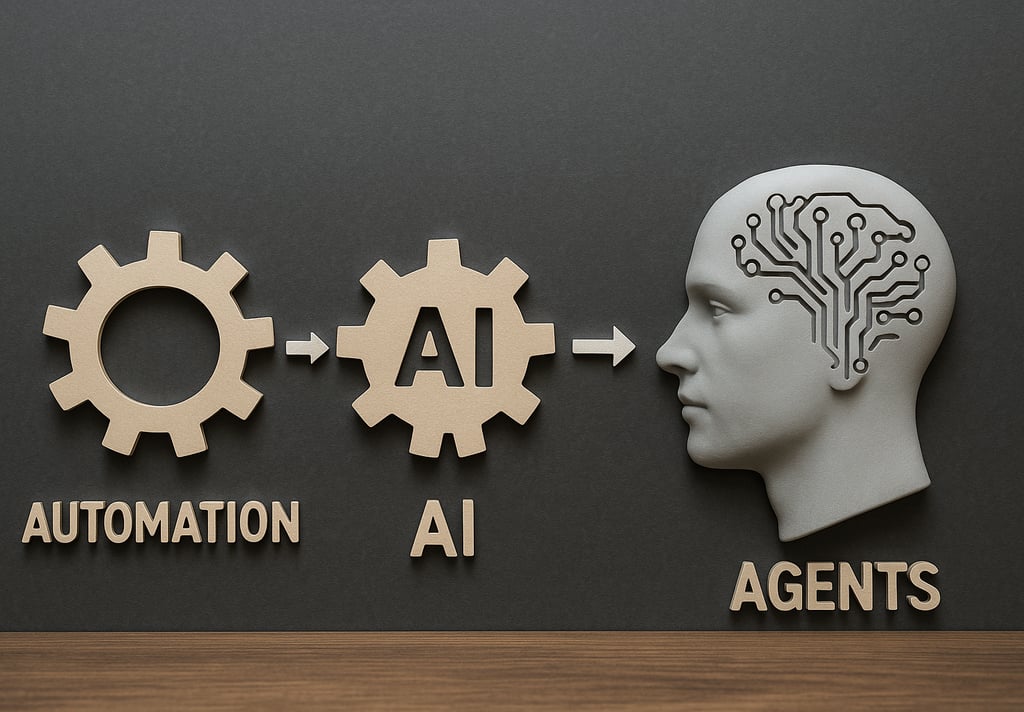
The evolution from automation → AI automation → AI agents mirrors how organizations are scaling efficiency and intelligence in their operations.
Automations streamline repetitive work.
AI automations bring understanding and judgment.
AI agents enable independent reasoning and continuous learning.
As these technologies mature, we’re witnessing the rise of systems that don’t just follow instructions but understand objectives, adapt to context, and collaborate intelligently.
The key takeaway is that automation is no longer just about saving time, it’s about building systems that can think, decide, and act.
By mastering the distinctions between basic automation, AI automation, and AI agents, individuals and organizations can better plan their automation strategies and prepare for the next generation of intelligent digital workflows.
Subscribe to our newsletter
Stay ahead in the world of technology and innovation.